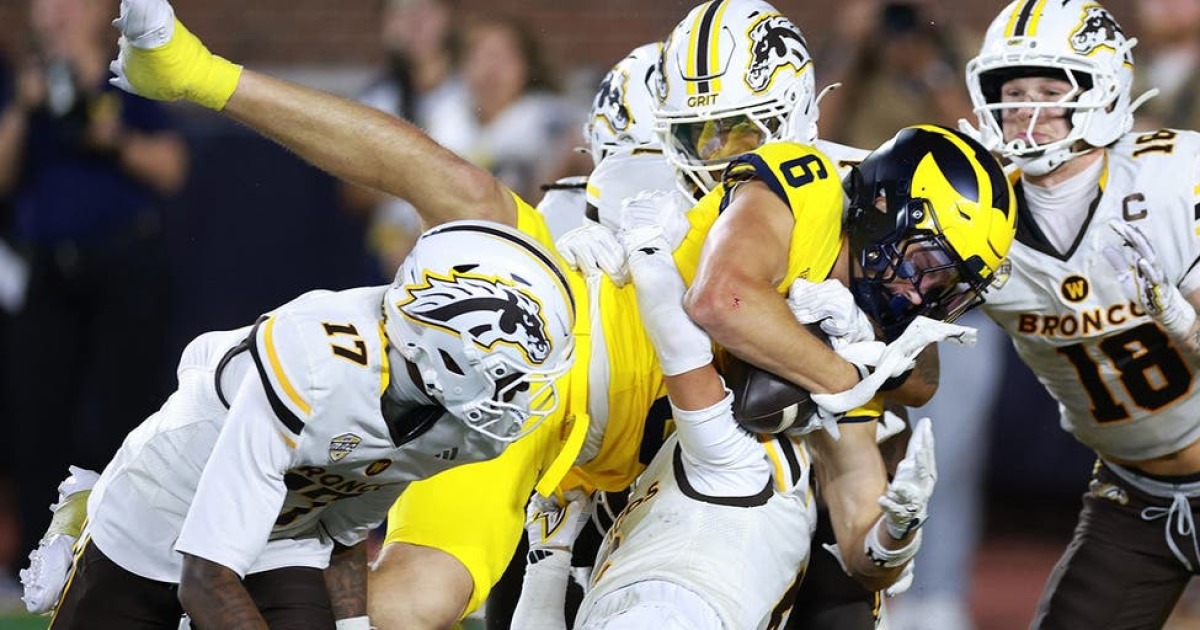
On September 5, 2026, the Michigan Wolverines secured a dramatic 13-12 victory over the Western Michigan Broncos at Michigan Stadium. The game concluded with a last-second 47-yard touchdown pass from Michigan quarterback Bryce Underwood to wide receiver JJ Buchanan, a play that was made possible by the addition of one second to the game clock during a replay review. This decision has since become the focal point of a formal appeal filed by the Mid-American Conference (MAC).
**The Controversial Final Play**
With 38 seconds remaining in the fourth quarter, Western Michigan led 12-7, and Michigan had no timeouts left. Underwood's initial Hail Mary attempt was intercepted and thrown out of the back of the end zone as time expired, seemingly sealing the Broncos' victory. However, during the subsequent replay review, the Big Ten Conference replay crew determined that one second remained on the game clock, allowing for an additional play. This decision enabled Underwood to connect with Buchanan for the game-winning touchdown.
**MAC's Appeal to NCAA and CFP**
In response to the controversial ending, MAC Commissioner Dr. Jon Steinbrecher announced on September 8, 2026, that the conference had submitted formal appeals to both the NCAA FBS Oversight Committee and the College Football Playoff (CFP). The MAC contends that the replay crew did not adhere to established protocol by relying on the clock feed embedded within their replay system, rather than the game clock displayed on the program feed. According to the MAC, this procedural error led to the addition of one second to the game clock, resulting in an unfair advantage for Michigan. The conference is requesting that both the NCAA and CFP recognize Western Michigan as the actual winner of the game for purposes of rankings, evaluations, and selection deliberations. ([getsomemaction.com](https://getsomemaction.com/news/2026/9/8/official-statement-regarding-western-michigan-michigan-football-game.aspx?utm_source=openai))
**NCAA's Response**
The NCAA has responded to the MAC's appeal by stating that it does not have a protocol for overturning the outcome of a game. The Division I Football Bowl Subdivision Oversight Committee does not possess the authority to alter game results. According to the NCAA Football Rules Book, the team with the most points at the end of the game is declared the winner, and the score is final when the referee declares the game has ended. ([cbsnews.com](https://www.cbsnews.com/detroit/news/ncaa-says-it-cant-overturn-michigans-win-over-western-michigan/?utm_source=openai))
**Implications for Western Michigan**
The MAC's appeal underscores the significant impact that the game's outcome could have on Western Michigan's season. A victory over a top-20 opponent like Michigan would have bolstered the Broncos' standing in national rankings and enhanced their prospects for a potential College Football Playoff berth. The appeal reflects the conference's commitment to ensuring fair play and adherence to established protocols, particularly in high-stakes situations.
**Looking Ahead**
As the NCAA and CFP have indicated that they do not have the authority to overturn the game's outcome, it is unlikely that the result will be changed. The MAC's appeal, however, highlights the importance of procedural integrity in officiating and the potential consequences of perceived errors in critical moments. For Western Michigan, the focus will now shift to the remainder of their season, as they aim to build upon their performance and seek redemption in future games.
The controversy also serves as a case study for the broader college football community, emphasizing the need for clear and consistent application of replay protocols to maintain the integrity of the game. Stakeholders at all levels will be closely monitoring the situation to assess the effectiveness of current procedures and consider potential reforms to prevent similar issues in the future.
In conclusion, while the MAC's appeal is unlikely to alter the outcome of the Michigan-Western Michigan game, it brings to light critical discussions about officiating standards and the importance of procedural accuracy in college football. The situation serves as a reminder of the fine line between victory and defeat and the profound impact that a single decision can have on the trajectory of a team's season.