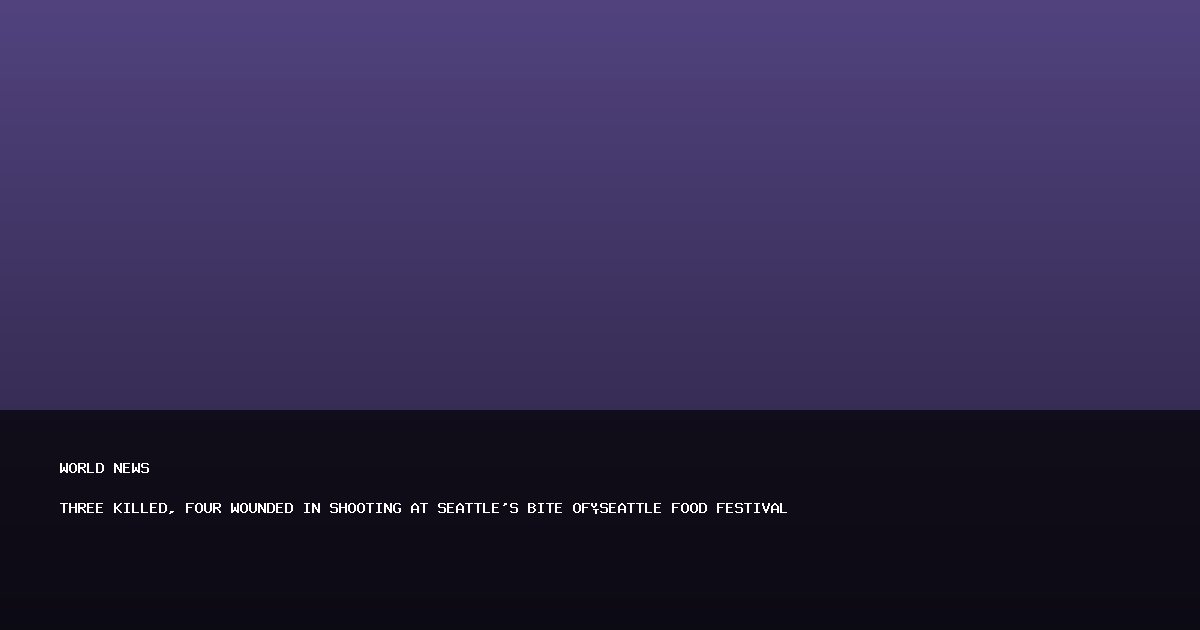
A shooting at the Bite of Seattle food festival on the evening of July 26, 2026 left three people dead and at least four others injured, transforming a popular summer gathering near the city's iconic Space Needle into a scene of chaos and grief. Police say the gunfire appears to have erupted from a confrontation between two armed individuals amid a crowd of festivalgoers at Seattle Center, one of the city's busiest public gathering spaces.
What Happened
According to accounts from CBS News, CNN, NBC News and ABC News, shots rang out at Seattle Center at approximately 6 p.m. local time on Sunday, during one of the final stretches of the multi-day Bite of Seattle festival, an annual food and entertainment event that draws large crowds to the campus surrounding the Space Needle. Investigators believe the gunfire originated from what they have characterized as a shootout between two gunmen, rather than a single active-shooter scenario, though the precise sequence of events, including what triggered the confrontation, remained under investigation as of initial reporting.
Emergency responders, including Seattle Police and fire department paramedics, arrived rapidly given the festival's existing security presence, but the dense crowd complicated both the response and the subsequent effort to secure the scene and identify witnesses.
The Victims
Officials confirmed that three people died as a result of the shooting: a 19-year-old man, a 44-year-old man, and a 56-year-old woman, an age range that underscores how indiscriminately gunfire in a crowded public space can affect victims who may have had no connection to whatever dispute triggered the shooting. Four additional people were injured. A boy, a 23-year-old man, and a 39-year-old woman were reported in stable condition following treatment, while a 40-year-old woman suffered minor injuries and declined transport to a hospital.
Names of the victims had not been released publicly at the time of initial reporting, pending family notification, a standard practice in the immediate aftermath of a fatal shooting.
The Suspects and Ongoing Investigation
Police said one of the two suspected gunmen surrendered to officers after being confronted at the scene. A second suspect fled Seattle Center and was the subject of an active search by law enforcement, including agents from the Bureau of Alcohol, Tobacco, Firearms and Explosives (ATF) Seattle field office, who routinely assist local police with firearms tracing and ballistics analysis in multi-casualty shootings.
Investigators have not publicly detailed a motive for the confrontation. As is standard in the early hours of a major violent crime investigation, authorities urged anyone with video, photos, or firsthand accounts of the incident to come forward, given the number of festivalgoers likely to have captured footage on personal devices amid the large crowd.
Seattle Center and the Bite of Seattle Festival
Seattle Center is among the most heavily visited public spaces in the Pacific Northwest, home to the Space Needle, the Chihuly Garden and Glass museum, and numerous other cultural institutions, and it regularly hosts large festivals and public events throughout the summer months. The Bite of Seattle, one of the city's signature annual food festivals, has run for decades and typically draws tens of thousands of attendees over the course of its multi-day run, featuring dozens of food vendors, live music, and family-oriented programming.
The scale and popularity of the event is part of what makes Sunday's shooting especially jarring for residents: Seattle Center is generally regarded as a family-friendly civic space, and the festival is a well-established fixture of the city's summer calendar rather than a venue associated with prior violence.
Community and Official Reaction
Local officials, including Seattle Police Department leadership, characterized the shooting in stark terms, with early statements from responding officers describing the scene as one of "horrific violence," language echoed in initial ABC News reporting. City leaders were expected to address the incident more fully in the days following the shooting, including any plans to review security protocols at large public events held at Seattle Center going forward.
Community reaction, as is common after mass-casualty shootings at public gatherings, has combined grief for the victims with renewed public debate over gun violence, event security, and the adequacy of existing safety measures at large outdoor festivals. Some attendees described a chaotic scene as the crowd scattered when gunfire began, a common and consistent element of witness accounts from shootings in dense public settings.
Broader Context: Gun Violence at Public Events
The Seattle Center shooting adds to a wider pattern that has drawn sustained attention from researchers and law enforcement in recent years: gun violence occurring not in isolated locations but amid crowded public gatherings, including festivals, parades, and other large outdoor events. Such incidents present distinct challenges for both prevention and emergency response, since large crowds can both obscure early warning signs of a developing conflict and complicate evacuation and medical response once shooting begins.
In response to a series of high-profile shootings at public events across the United States in recent years, many cities have expanded security measures at major festivals, including metal detection, bag checks, and increased uniformed police presence. It remains to be seen whether Seattle officials will announce enhanced measures for future events at Seattle Center following Sunday's shooting, though such reviews are a common response from city governments after high-profile incidents at municipally operated venues.
Common Questions From Readers
Readers following the story have asked whether the shooting was targeted or random; officials have not yet characterized it definitively as either, beyond describing it as an apparent confrontation between two armed individuals rather than a broader attack on the crowd. Questions have also focused on festival safety more broadly, including what screening measures, if any, were in place at the event's entrances, details that are likely to emerge as the investigation and any resulting public accountability process continues.
What to Watch Next
In the days ahead, expect Seattle police to provide updates on the search for the second suspect, along with additional information about the identities of the victims once families have been notified. City officials are also likely to face questions about festival security protocols and whether changes will be made for future large-scale public events at Seattle Center. National gun violence researchers and advocacy organizations, on both sides of the policy debate, will likely cite the incident in ongoing discussions about firearms policy and public event safety, a pattern common after high-profile shootings involving multiple casualties in public spaces.
As with any actively developing investigation, some early details, including the exact circumstances that led to the confrontation between the two suspects, may be revised or clarified as police complete their investigation and release further findings.
Seattle's Recent History With Gun Violence
Sunday's shooting adds to a series of high-profile gun violence incidents that have periodically struck Seattle's public spaces in recent years, a pattern echoed in many major American cities. While Seattle Center itself has largely avoided the kind of recurring violence associated with some entertainment districts, the broader Puget Sound region has, like much of the country, seen periods of elevated shooting incidents tied to disputes among small numbers of individuals that nonetheless endanger uninvolved bystanders in crowded settings, precisely the dynamic authorities describe in Sunday's incident.
City leaders in Seattle have in recent years pursued a mix of community violence intervention programs, targeted policing strategies, and youth outreach efforts aimed at reducing shootings tied to interpersonal disputes, an approach broadly consistent with strategies adopted in other major U.S. cities. Whether any of those existing programs intersect with the individuals involved in Sunday's shooting is not yet publicly known and would likely only become clear as the police investigation progresses and, potentially, as any resulting criminal charges are filed.
The National Debate Over Public Event Security
Shootings at large public gatherings, including festivals, parades, and outdoor concerts, have become a recurring flashpoint in the broader national debate over gun policy and public safety in the United States. Proponents of stricter security measures argue that events drawing tens of thousands of attendees, like the Bite of Seattle, warrant airport-style screening, including metal detectors and bag searches, pointing to reduced-incident rates at venues that have adopted such measures. Critics counter that comprehensive screening at open, sprawling public spaces like Seattle Center is logistically difficult and prohibitively expensive to implement effectively, and that determined individuals seeking to carry a concealed weapon into a crowd can often circumvent even robust security perimeters.
On the policy side, the shooting is likely to be cited by advocates on multiple sides of the gun policy debate. Gun control advocates typically point to such incidents as evidence for the need for stricter firearms regulations, including expanded background checks or restrictions on carrying firearms in dense public spaces. Gun rights advocates, meanwhile, often emphasize that shootings resulting from disputes between individuals who evade existing laws underscore enforcement gaps rather than a need for new legislation, and may point to armed citizen intervention or existing concealed-carry laws as part of the response framework. Both perspectives are likely to feature in the public conversation as Seattle officials weigh their response to Sunday's shooting.
How Mass-Casualty Shootings at Festivals Are Investigated
Investigations into shootings involving multiple shooters and numerous casualties in a crowded public space follow a fairly standardized law enforcement process, beginning with securing the scene, triaging victims, and establishing a perimeter to search for evidence and witnesses. In cases like Sunday's, where one suspect surrendered at the scene and a second fled, investigators typically pursue several parallel lines of work: interviewing the suspect in custody, reviewing surveillance and cellphone video from the dense crowd of festivalgoers, and using ballistic evidence recovered from the scene to help reconstruct the sequence of gunfire.
The involvement of ATF agents, standard in incidents involving multiple firearms, typically focuses on tracing the origin and ownership history of the weapons used, information that can help investigators establish how the suspects obtained their firearms and whether either had a prior record that should have legally barred them from possessing a gun. That tracing process can take days or weeks to fully resolve, meaning some details about the origins of Sunday's shooting may not become public until later stages of the investigation.
Impact on the Local Community
Beyond the immediate victims and their families, mass-casualty shootings at beloved community events like the Bite of Seattle tend to leave a broader psychological imprint on residents who have long associated the festival, and Seattle Center more broadly, with a sense of civic pride and family-friendly safety. Local business owners near Seattle Center, many of whom rely on major summer festivals for a meaningful share of annual revenue, are also likely to face near-term impacts, both from the immediate disruption of the event and from any longer-term wariness among attendees at future gatherings in the same location.
Grief counselors and crisis response teams are typically deployed by city agencies following incidents of this scale, both for direct victims' families and for the broader population of festivalgoers who witnessed the violence firsthand, given the well-documented psychological impact of witnessing gun violence even among those not physically injured.
Comparing This Incident to Other Festival Shootings
Sunday's shooting joins a difficult national catalogue of gun violence at public festivals and gatherings across the United States over the past decade, incidents that have varied widely in scale, motive, and outcome, from disputes between small numbers of individuals that endangered bystanders to larger-scale attacks targeting crowds directly. Public safety researchers who study these events note that shootings stemming from disputes between specific individuals, as investigators believe occurred in Seattle, tend to differ meaningfully in both prevention strategy and investigative approach from attacks where a shooter targets a crowd indiscriminately, even though the resulting bystander casualties can be similarly severe in both scenarios.
That distinction matters for how cities respond in the aftermath: incidents rooted in interpersonal disputes have prompted some cities to expand weapons-detection screening and increase visible security presence specifically in food and beverage areas of festivals, where disputes are statistically more likely to arise, rather than uniformly restructuring an entire event's security posture.
Key Facts at a Glance
- Shooting occurred around 6 p.m. on July 26, 2026 at the Bite of Seattle festival, Seattle Center.
- Three people died: a 19-year-old man, a 44-year-old man, and a 56-year-old woman.
- Four others were injured, most in stable condition.
- Police describe it as a shootout between two gunmen; one surrendered, one fled and was being sought.
- ATF agents assisted Seattle Police in the investigation.
This article summarizes publicly reported developments regarding the Seattle Center shooting and will be updated as more information becomes available.